
Pillar 3: Beyond the Numbers
September 2026. Market discipline starts past the published ratio: with the formula that constrains it, and with who controls the bank.

The frontier of market discipline sits beyond just the numbers disclosed in a bank’s Pillar 3 report.
A Pillar 3 report tells us a great deal about a bank’s risk profile, and the standardization embedded into the Pillar 3 framework makes it very easy for stakeholders to benchmark and inform opinions with confidence.
A Pillar 3 report tells us less about the regulatory assumptions and calculations that help shape a bank’s risk profile and the incentives of the owners who ultimately control the institution.
In this month’s issue of Pillar 3+ Monthly, we shine a spotlight on the “+” with context provided by my own practical experience as a Pillar 3 stakeholder and a recent Wall Street Journal article focused on one specific corner of the U.S. banking industry — private-equity ownership.
Benchmarking begins with understanding

The public disclosure standards embodied in the Basel framework enhance market discipline by requiring banks to release information using standardized templates, common definitions, and prescribed reporting structures, thereby improving transparency and comparability across institutions.
The current Basel Disclosure Requirement Standard (DIS) includes 82 templates, 15 for qualitative information only and 67 for quantitative data or a mixture of both.
At their core, the templates are designed to make disclosures directly comparable. By requiring banks to report key risk and capital metrics using common definitions and formats, the Basel framework helps stakeholders cut through reporting differences, compare banks on a like-for-like basis, and make more informed judgments about risk, capital allocation, and overall financial resilience.
Presentation conventions, however, are left to the banks and national supervisors. The choice of reporting units displayed for values and the number of decimal places displayed for ratios, what some may call trivial, can, in fact, have a large impact when it comes to benchmarking.
Pillar 3 was originally conceived as a human-readable disclosure framework, and the Basel Committee generally prioritized usability for stakeholders when it came to reading a particular bank’s report.
Standardized units and decimal places become much more important when the objective shifts from human consumption to automated aggregation and machine-based analytics.
The Basel Committee opened a consultation in December 2025 on Machine-Readable Pillar 3 Disclosure.1 In the response letter I wrote on behalf of the GARP President and CEO, I spoke to the need for stakeholders to have access to data with the utmost granularity.2
By way of example, during some routine analysis work on the leverage ratio framework in the U.K., I discovered that using Pillar 3 data “as published” generated incorrect results as regards the binding constraint nature of the framework.
Some background: lessons from the Global Financial Crisis
Prior to 2008, banks were primarily constrained by risk-weighted capital ratios — “constrained” in the sense that falling below the minimum level set by national regulators and supervisors risked limitations on capital deployment or balance sheet expansion.
A major lesson from the Global Financial Crisis was that some banks appeared well-capitalized on a risk basis while simultaneously carrying very large nominal exposures.
As part of the post-crisis revision of the Basel framework, the Basel Committee introduced the leverage ratio as a simple, non-risk-based backstop to the risk-based capital framework.
Under Basel III, the leverage ratio is defined as
Tier 1 capital / Total exposure measure
with a minimum requirement of 3%.
U.K. support
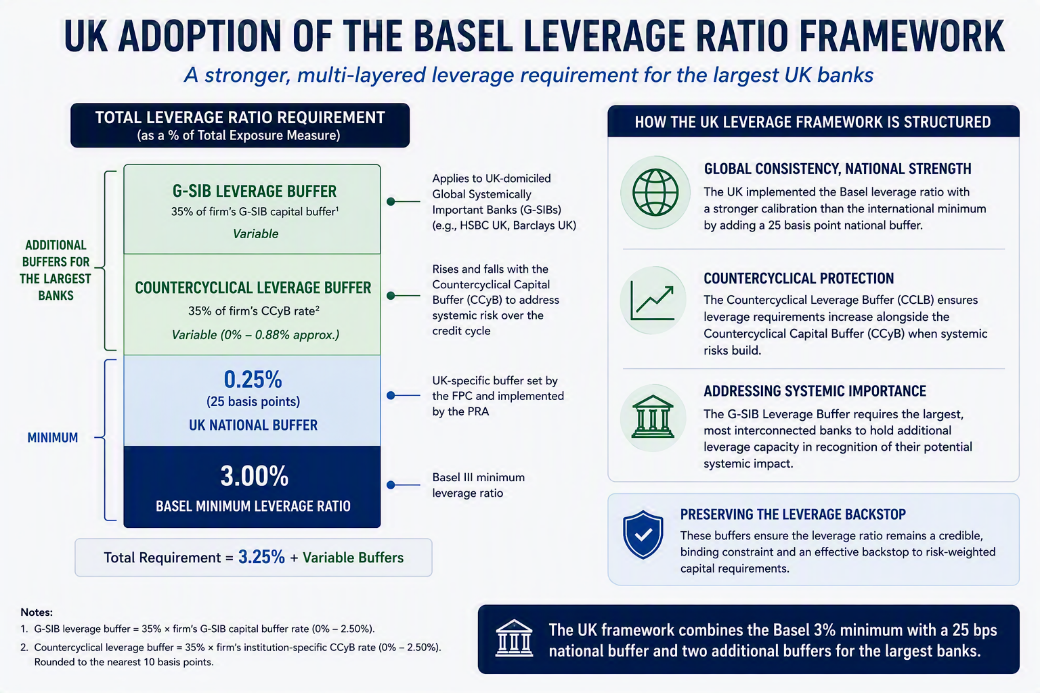
Early and/or more stringent adoption of the components of the Basel framework was the theme of my newsletter from last month.
Continuing that theme, the Financial Policy Committee, the U.K.’s macroprudential regulator responsible for safeguarding the stability of the financial system as a whole, was among the strongest advocates for a leverage ratio and, in 2013, recommended that major U.K. banks strengthen their leverage positions well before the Basel leverage ratio became a formal Pillar 1 requirement.
The Prudential Regulation Authority, the U.K.’s microprudential regulator responsible for the regulation and supervision of financial institutions, in December 2015, adopted the leverage ratio as policy for the largest U.K. banks and building societies and with a stricter hurdle than the global minimum in the form of a 25-basis point buffer.
Furthermore, recognizing that systemic risk can build even when risk weights appear benign, the FPC and PRA implemented a second leverage buffer tied to the Countercyclical Capital Buffer (CCyB) to ensure that leverage constraints tightened as the credit cycle matured and risk accumulated.
Finally, to address the systemic risks posed by the largest and most interconnected banks, the FPC and PRA introduced a third leverage buffer that increases leverage requirements in proportion to a bank’s systemic importance.
When the formula matters more than the figure — a tale of two banks
Key figures as regards capital and leverage requirements are published in the Key Metrics (KM1) and Leverage Ratio Common Disclosure (LR2) tables, two of the 82 Disclosure Requirement Standard templates mentioned above.
The formulae used to calculate capital and leverage requirements reside in the PRA Rulebook.
Barclays
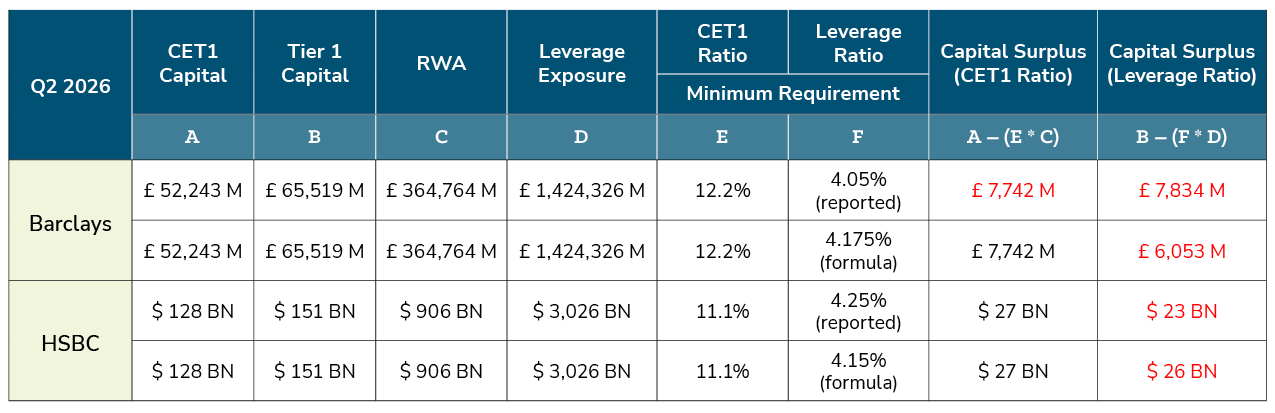
In its Q2 KM1 table, Barclays reports a CCyB of 1.0% and a CCLB of 0.3%.
The PRA Rulebook calibrates the Countercyclical Leverage Buffer (CCLB) at 35% of the CCyB “expressed as a percentage rounded to the nearest tenth of a percentage”.
CCLB, Barclays = 1.0% × 0.35 = 0.35%
The PRA Rulebook does not specify a particular rounding method, but conventional rounding would represent the Q2 CCLB for Barclays as 0.4%, 10 basis points higher than what is reported.
Barclays reports, also in its KM1 table, a G-SIB capital buffer of 1.5% and a G-SIB leverage buffer of 0.5% in its LR2 table.
Here again, the PRA Rulebook calibrates the G-SIB leverage buffer at 35% of the G-SIB capital buffer but with no mention of rounding.
G-SIB leverage buffer, Barclays = 1.5% × 0.35 = 0.525%
While the reported G-SIB leverage buffer does not suffer from rounding, it does suffer from a reporting convention that limits a ratio value to a single decimal place.
HSBC
In its Q2 KM1 table, HSBC reports a CCyB of 0.7% and a CCLB of 0.3%.
According to the formula in the PRA Rulebook:
CCLB, HSBC = 0.7% × 0.35 = 0.245% (0.2% when rounded)
The obvious challenge this presents for stakeholders is that two banks report different CCyB values yet, paradoxically, report identical CCLB values.
HSBC reports a 2.0% G-SIB capital buffer and a 0.7% G-SIB leverage buffer for Q2.
G-SIB leverage buffer, HSBC = 2.0% × 0.35 = 0.7% (the value as reported)
The imprecision with respect to the CCLB manifests itself when determining whether a bank is constrained on the basis of risk or on the basis of leverage.
Based solely upon the values reported in the Pillar 3 report, a stakeholder would determine that Barclays is constrained on a risk basis. The situation reverses itself based upon a minimum leverage requirement calculated in accordance with the PRA Rulebook.
HSBC is constrained on a leverage basis under both scenarios, but the formula-based approach, combined with the fact that HSBC reports input values in billions, narrows the gap significantly.
Why is this important?
Pillar 3 has succeeded in bringing consistency and transparency to bank disclosures, but using Pillar 3 data at face value alone does not guarantee complete understanding. As the cases of Barclays and HSBC illustrate, the same set of reported figures can lead to very different conclusions depending on how the underlying regulatory requirements are calculated and interpreted.
For analysts, investors, and other stakeholders, market discipline begins not with the reported ratio, but with understanding what constrains it.
The future of meaningful benchmarking lies beyond the numbers themselves and in the methodologies, assumptions, and supervisory judgments that give those numbers meaning. After all, before we benchmark a number, we must first understand the number.
The numbers tell part of a story. Ownership tells the rest.

Pillar 3 is often viewed as the cornerstone of market discipline, but constructing a complete risk profile of a bank oftentimes requires looking beyond the Pillar 3 disclosure reports.
Ownership and control, two aspects that can fundamentally shape risk appetite and business strategy, remain largely invisible within the Pillar 3 framework.
Ownership and control are generally not front-of-mind considerations for bank analysts.
The majority of banks are publicly traded, with strategic direction ultimately overseen by an independent board accountable to shareholders and market discipline instilled by virtue of broadly dispersed shareholder bases.
Ownership and control are often taken as a given.
Yet, ownership and control structures can and do vary significantly across the global banking industry. State ownership is one of the most prominent examples. Whereas banks that are widely held are typically governed through the collective influence of institutional and retail investors, state-owned banks may be influenced by a broader set of public policy objectives alongside commercial considerations.
China exemplifies this model, with government ownership playing a significant role in many of the country’s systemically important banking institutions.
Private-equity ownership, another example where ownership and control are concentrated, became part of the banking landscape following the Global Financial Crisis and remains a fixture today.
As a result, understanding a bank’s ownership structure becomes a critical component of assessing governance, strategic decision-making, and the mechanisms through which control is exercised.
The U.S. banking sector and the rise of private-equity investors
The Wall Street Journal ran an article on September 7 focused on a very interesting bank merger in the U.S. expected to close in early 2027.
EverBank Financial Corp, a regional bank based in Jacksonville, Florida, has entered into a reverse merger with WaFd, another regional bank, based in Seattle, Washington, ending a 10-year period of private ownership.
Background
Of the roughly 4,500 FDIC-insured banks in the United States, only a small fraction is controlled by private investors.
U.S. regulators have traditionally been cautious, and at times openly sceptical, about private ownership since the traditional private model can be difficult to reconcile with the public-policy objectives of banking regulation.
- Investment horizon. Banks are expected to operate as long-term institutions serving depositors, borrowers, and communities, whereas private investors are typically organized around finite investment horizons and eventual exit strategies.
- Leverage and risk appetite. Private investors are often associated with aggressive growth strategies, acquisitions, and higher return targets.
- Source-of-strength considerations. Banks are generally expected to serve as a “source of strength” during periods of stress. Regulators question whether private investors would be willing or able to provide ongoing support to a troubled bank.
- Transparency and complexity. Private ownership structures can be complex, involving multiple funds, co-investors, and layered legal entities. For regulators, the key question is, “Who actually controls a bank?”
Private-equity investors established a toehold in the U.S. banking sector during the post-Global Financial Crisis period when sponsors stepped in to recapitalize failed and distressed banks. There were 489 bank failures during the crisis. Of these, 463 were resolved through normal regulatory mechanisms arranged by the FDIC.
Private-equity investor groups played a meaningful role in a subset of those transactions and were viewed as an important source of capital when many traditional bank buyers themselves were under stress.
Nevertheless, the FDIC issued a policy statement in 2009 that imposed special conditions on private-equity investors seeking to acquire failed banks, including enhanced capital expectations and other restrictions.
The next wave of involvement took place during the late 2010s and early 2020s when sponsors acquired niche or specialty banking platforms.
Today, private-equity firms view banks as attractive funding platforms for private credit and specialty finance activities.
That said, the number of banking organizations controlled by private-equity firms is estimated to be in the dozens rather than in the hundreds.
An important recent development is that in March of this year the FDIC rescinded the 2009 policy. In announcing the change, the FDIC explicitly recognizes that private-equity firms can provide substantial capital and may play an important role in bank resolutions.
EverBank Financial Corporation
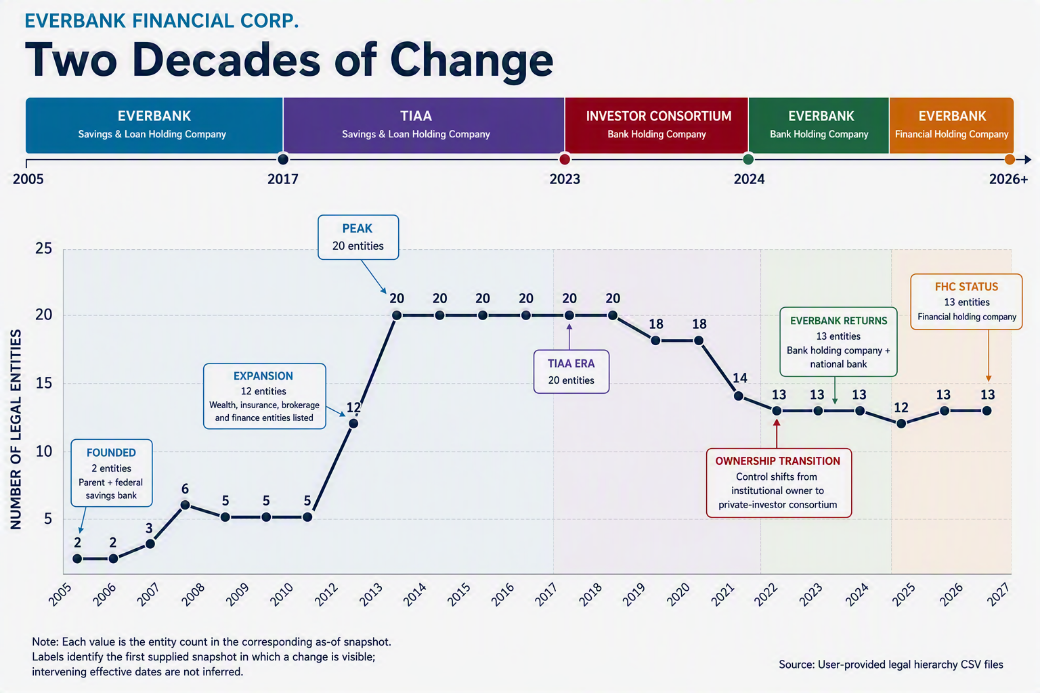
EverBank was taken private during the second wave when, in June of 2017, Teachers Insurance and Annuity Association of America (TIAA) acquired the bank in an all-cash acquisition.
TIAA, at the time, viewed the purchase as a way to transform itself from a retirement- and wealth-focused organization into a more comprehensive financial services provider.
TIAA subsequently exited the investment in 2023 and sold EverBank to a group of private-equity investors, citing, interestingly enough, a need to return to its core retirement, wealth-management, and asset-management businesses.
Now, three years on, the private-equity investor group appears to be doing exactly what such investors are expected to do: monetize a successful investment after a period of growth and value creation. This three-year investment period is consistent with the horizon many private-equity firms take before evaluating exit opportunities.
The reverse merger with WaFd, a public company, will return EverBank to publicly owned status, the same banking franchise having served three very different strategic purposes: as a public company, as a wholly owned subsidiary supporting the goals of a retirement-services organization, and as a private-equity-backed banking platform.
While the proposed merger with WaFd returns EverBank to the public markets, it is important to note that the private equity investor group will retain an ownership position of approximately 59.2%, giving them future liquidity and valuation flexibility.
Why is this important?
Market discipline is often viewed through the lens of financial disclosures, with analysts focusing on capital ratios, asset quality, liquidity, profitability, and other measures of risk. Yet ownership and control are equally important determinants of a bank’s strategic direction and governance.
Public listing and dispersed ownership are frequently regarded as prerequisites for effective market discipline, but a publicly traded bank is not necessarily a widely controlled institution. A controlling shareholder or investor group may retain significant influence over board composition, capital allocation, acquisition strategy, growth objectives, and risk appetite, shaping the trajectory of the institution in ways that may not be readily apparent from its financial disclosures alone.
As a result, assessing the effectiveness of market discipline requires more than determining whether a bank’s shares are publicly traded. It also requires an understanding of who exercises control and the incentives that drive decision-making. Public markets may provide transparency, liquidity, and access to capital, but they do not necessarily eliminate the influence of concentrated ownership.
For investors, counterparties, and other stakeholders, ownership and control therefore provide important context that complements, rather than replaces, the information contained in Pillar 3 reports and financial statements. Understanding who controls a bank may be just as important as understanding its capital ratios, liquidity position, or earnings performance.
1. Basel Committee on Banking Supervision, “Machine-readable Pillar 3 disclosure” (consultative document, Bank for International Settlements, 5 December 2025), https://www.bis.org/publications/202512-consultation-machine-readable-pillar-3-disclosure.
2. Global Association of Risk Professionals (GARP), “Comment Letter on the Basel Committee’s Consultation on Machine-readable Pillar 3 Disclosure,” submitted to the Basel Committee on Banking Supervision, 5 March 2026, https://www.bis.org/2026-07/garp.pdf.