Above the Basel minimum: why China’s banks keep a larger capital buffer
China adopted a leverage ratio early and set the national floor at 4%, above the Basel minimum of 3%. The first-quarter 2026 disclosures show a wider buffer than at other major G-SIBs.
Adopting a Basel standard ahead of the Committee’s timetable is rarely only a compliance choice. For authorities that move early, it is also a statement of supervisory stance. It can reflect confidence in the domestic framework, a wish to hold local banks to a tighter constraint, or a signal to markets and other stakeholders. Jurisdictions do not all do this the same way. Some bring the Basel framework forward as a whole. Others advance a single requirement, and some set the bar above the Basel minimum.
China is a clear case of the second pattern.
Two years after the Basel Committee introduced the Basel III leverage-ratio framework, China put the requirement in place, nearly six years before it became a binding requirement in other regions.
The National Financial Regulatory Administration (NFRA) now applies a national minimum leverage ratio of 4%, 100 basis points above the Basel minimum of 3%. Chinese banks therefore face a higher leverage requirement, and the rule sends a plain signal: a resilient balance sheet matters more than merely clearing the lowest compliance threshold.
Leverage is built into the banking model. A bank supports a balance sheet of loans and other investments with a relatively limited amount of equity, and those assets expose it to credit and valuation risk.
Leverage therefore creates solvency risk and belongs inside prudential supervision. One measure of that risk is equity relative to the size of the balance sheet: the leverage ratio.
From the founding of the People’s Republic in 1949 until 1998, China’s credit system was organised around the People’s Bank of China (PBOC). Under the early mono-bank system, credit was allocated mainly according to the government’s production plans.
A commercial banking system in the modern prudential sense took shape mainly in the financial reforms of 1994 and 1995. Policy finance was separated from commercial finance, and the state specialised banks began the shift toward commercial banks.
The Law on the People’s Bank of China and the Commercial Banking Law gave that system its legal base, and put in place a governance framework of balance-sheet constraints, capital requirements and prudential supervision.
Article 39 of the Commercial Banking Law once required that a commercial bank’s loans not exceed 75% of its deposits. Strictly speaking, the loan-to-deposit ratio is not a leverage ratio. Until the requirement was changed in 2015, though, it did limit how far a bank could lever its balance sheet.
The United States and Canada, by contrast, had introduced leverage requirements in the modern sense in the early 1980s.
Chinese supervisors also restrained balance-sheet growth directly, for example by limiting credit to particular industries or by constraining a bank’s expansion plans.
For a long period, then, leverage in Chinese banking was held in check by supervisory judgment and administrative constraint, not by a published, quantitative leverage-ratio rule.
Basel III: a global break
The United States and Canada adopted the idea of a leverage ratio early, but before the Global Financial Crisis few jurisdictions set an explicit leverage constraint.
After the crisis, the Basel Committee recognised that risk-weighted capital requirements alone would not stop balance sheets from expanding too far. When the first round of global reforms was launched in 2010, the leverage ratio was brought into the Basel III framework.
The Basel leverage ratio is Tier 1 capital divided by total on- and off-balance-sheet exposures. The minimum is 3%.
China: an early adopter
In 2011 China issued the Administrative Measures on the Leverage Ratio of Commercial Banks. As part of the broader Guiding Opinions on the Implementation of the New Regulatory Standards in the Chinese Banking Industry, the rule followed almost immediately on the 2010 Basel reforms, well ahead of most jurisdictions that apply Basel standards. From the start, China set the minimum leverage ratio at 4%, 100 basis points above the Basel minimum of 3%.
Basel guidance and national practice
Since it was established in 1974, the Basel Committee has worked toward minimum prudential standards that can be agreed globally. How those standards are applied is still decided by each jurisdiction, through its own regulation and supervision.
The Basel minimum is therefore a floor for global prudential regulation. When a jurisdiction writes the framework into domestic rules, it can choose a more conservative requirement if that serves its own policy.
Supervisors can also set a higher standard for one bank, or for a class of banks, after a prudential assessment. Global systemically important banks (G-SIBs) are the obvious example.
Twenty-nine banks are currently designated G-SIBs. Five are from mainland China.
On top of the national minimum, the NFRA sets additional buffer requirements bank by bank, taking account of the macroprudential views provided by the People’s Bank of China.
Stakeholders can see how a bank is meeting those requirements through the market-discipline mechanism of Pillar 3.
A higher standard
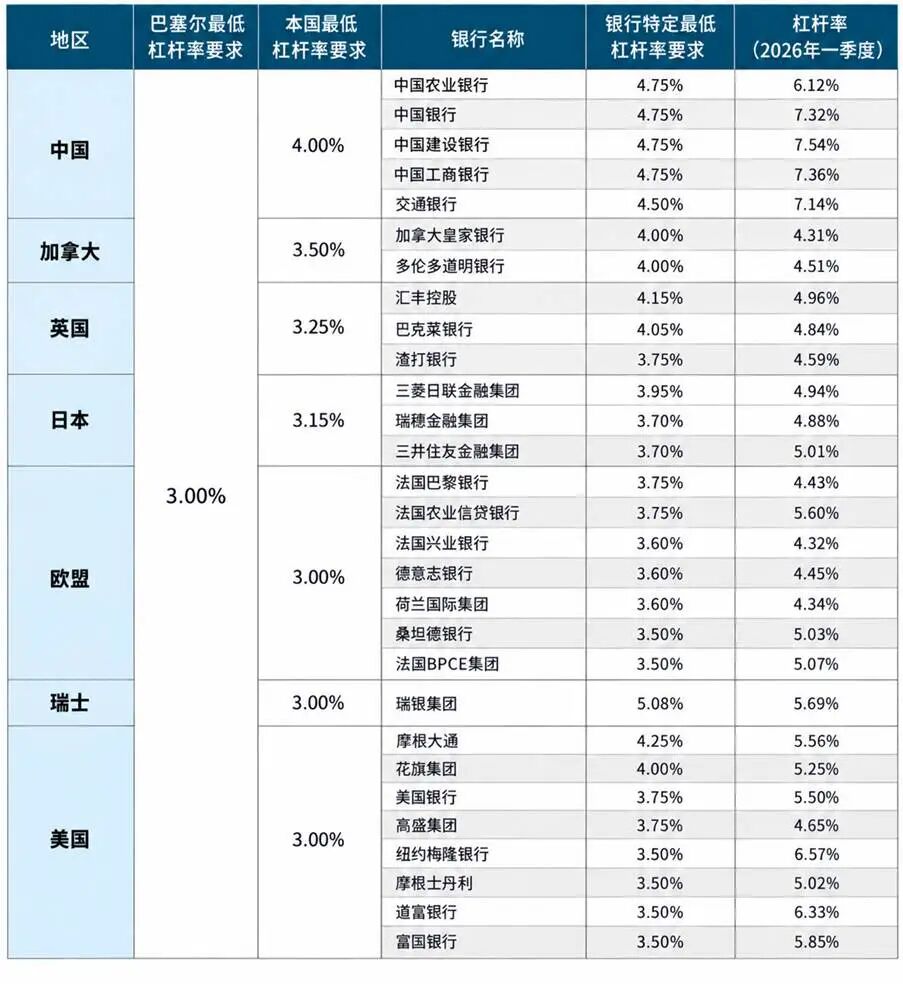
The table below covers the main Basel jurisdictions that are home to G-SIBs. It shows each jurisdiction’s national minimum leverage ratio, the minimum that applies to each G-SIB, and the leverage ratio the bank disclosed under Pillar 3 for the first quarter of 2026.
On that comparison, China keeps the highest national minimum leverage ratio among these jurisdictions. Bank-specific floors on top of that minimum are used to keep business quality in view and to avoid business models and balance sheets that expand too quickly.
Canadian banking is concentrated, and the market is led by a small number of large firms. The Office of the Superintendent of Financial Institutions (OSFI) has long tended to set baseline capital and leverage requirements for those banks a little above the Basel minimum.
In 2022 the Japan Financial Services Agency raised the minimum leverage ratio from 3% to 3.15%. That change does not mean the Japanese authorities found the Basel standard insufficiently prudent. It followed from the post-pandemic framework, and from the treatment of Bank of Japan reserves in the leverage exposure measure.
The UK Prudential Regulation Authority made a similar adjustment at the end of 2017, raising the minimum leverage ratio from 3% to 3.25%.
The Japanese and British adjustments were mainly to keep the measure neutral, not to tighten the leverage requirement in substance. The European Union, Switzerland and the United States still use the Basel minimum of 3%, and rely more on systemic-risk buffers, Pillar 2 and other tools for the risk of individual banks.
Supervision leaves a larger buffer
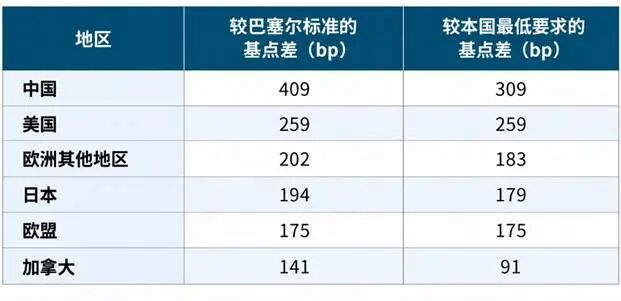
Leverage ratios disclosed for the first quarter of 2026 put China’s G-SIBs more than 400 basis points above the Basel minimum of 3%, and more than 300 basis points above China’s own national minimum of 4%. That buffer is higher than the buffer at G-SIBs in the other major Basel jurisdictions.
Room in the leverage buffer
The level of the ratio is not the only figure that matters. The gap between a bank’s leverage ratio and the minimum that applies to it decides how far the balance sheet can still grow if Tier 1 capital stays unchanged.
If the ratio falls into the buffer — below the bank-specific minimum, but still above the national minimum — the bank can face corrective action. A supervisor may require more Tier 1 capital within a set period, limit growth, or require exposures to be reduced.
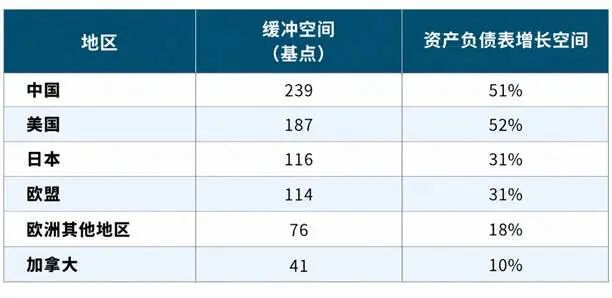
The table below shows the average leverage headroom of G-SIBs in each region, and the balance-sheet growth that headroom could support at the current level of capital.